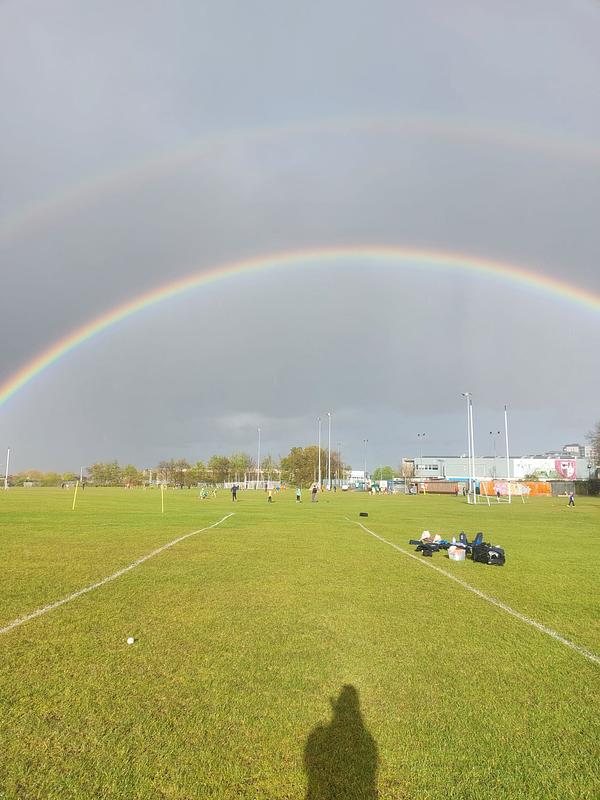
After our players and mentors, our clubhouse and playing pitches are the most important resources our club has. We are very fortunate that the majority of our training and playing needs are met by the pitches right beside our clubhouse. Not only is this convenient, it also helps to foster our club community – everyone from our academy to our senior teams train and play side by side. Few other clubs in Dublin are in such a fortunate position. We have two important updates to share: 1. Development of a new pitch alongside Benildus avenue 2. Pitch Usage Rules and Guidance
Pitch Development
The biggest news regarding our pitches is that we will begin construction of anew adult- sized pitch along Benildus Avenue from Monday, 20 April.
This will be a sand/soil mix pitch which will have drainage underneath, capable of absorbing high quantities of rain while remaining playable for much of the year. Funding for this redevelopment has been provided by a successful application for Sports Capital Grants, along with funds allocated by the Executive Committee.
This will have implications for training and matches. Redevelopment will mean closure of the area currently occupied by the Benildus Avenue pitch, part of the lower go games pitch, part of training area 1A and approximately one third of the lower juvenile pitch. As the lower juvenile pitch will no longer be usable in its current format, we will use the new mobile senior goals to create a temporary pitch in the lower area which will be used when we are over capacity. That along with increased access/rental of Stepaside and other all-weather facilities will minimise the impact on teams.
Work will take 12-15 months to complete. We will endeavour to minimise inconvenience as best we can and ask for everyone’s patience, co-operation and for a willingness to be flexible in relation to pitch and training allocations.
While the new pitch is being prepared, it will be all the more vital to protect and nurture our remaining playing areas. With everyone’s co-operation, we can minimise damage to our pitches from overuse and misuse. The alternative is to close pitches and playing space entirely to repair damage, which will incur extra costs to the club in the form of pitch rental and pitch repair – we’re anxious to avoid both the inconvenience of having to travel for matches and training, and additional costs for pitch maintenance. For more information on the club’s plans to improve our playing pitches, please see below.
Pitch Usage Rules and Guidance
Updated Pitch Usage Rules will be circulated to all teams and are summarised below. The club have purchased new sets of mobile goals which are now available for use. These will allow for training using full size goals while protecting the match day goal mouths and the heaviest traffic areas. This will remove any need for goal guards to be moved, except for matches.
Please be mindful when training on the pitches and follow these guidelines: • Do not use pitch surfaces for repetitive drills that involve running over the same area - these should be completed beside the playing area. • Vary the locations used for kick out practise and shooting practise to avoid overuse of typical weak spots (e.g., kick out spot on 14 and 21 yard lines, shooting arc, etc). • Do not remove goal guards without prior permission of the Pitches Committee – mobile goals should instead be used for training matches.
Our pitch allocator, Shane Pollard, can be reached at naomholafpitchallocator@gmail.com.
You’ll see that we have recently completed some much-needed maintenance on pitches, including the following: • Repair works on the upper senior pitch have been completed and the pitch is now back in use after a 4-week closure for repairs. • All damaged goal mouths and potholes have been repaired. • Shock waving (the deep slits in the pitches) has been completed, this reduces compaction, aids drainage and encourages root stabilisation and grass growth. We will be over-seeding (i.e., spreading a load of seed on the ground to bring on new grass) over the next few weeks. As ever, if you have any queries or anything else that you’d like to discuss, please feel free to reach out to any member of the Executive Committee: Terence O’Halloran, chair of the Pitches Committee • naomholafpitchescommittee@gmail.com / 087 2233451
Shane Whyte, Chairperson and Adult Games Committee • Chairperson.naomholaf.dublin@gaa.ie / 087 7455700 Eoin Kinsella, Vice Chair • Vicechairperson.naomholaf.dublin@gaa.ie / 087 6769280 Le meas, Naomh Olaf Executive Committee
Future Pitch Developments and Maintenance Plan
The redevelopment beginning this week is the first phase of four planned improvements to maximise the lower area for matches and training. Phase 1: New, adult-sized sand/soil mix pitch, with drainage, running parallel to Benildus Avenue Phase 2: Upgrading and conversion of the lower senior pitch to a sand/soil mix with drainage. Phase 3: Development of a large juvenile pitch. This will be developed where the ‘soccer’ pitch is currently located. It will be similar in size to the existing lower juvenile pitch and will also be a drained, sand/soil mix. Phase 4: Extension of the floodlights along Benildus Avenue and the Drummartin link road (alongside the lower senior pitch). The area marked in red below (New Senior) corresponds to Phase 1 above, which begins on 20 April. Phase 2 is marked in yellow, and Phase 3 in blue.
Pitch Maintenance You may remember that our pitches and training area were closed in December and January. This is likely to be an annual occurrence, as it gives the pitches much needed recovery time.
We have seen immediate benefits in the improved condition of the pitches over the last few weeks. The unplanned closure in February due to the unprecedented rain was, ironically, also beneficial for them as well. The vast majority of damage to pitches occurs in the winter months, so the less use they get from November to March the better for their general health and playability for the rest of the year.
Thanks to the huge community effort, our Skills Wall has now been in operation for almost a year. This has been hugely beneficial to all teams, especially the CCC1 (U8–U12) teams during the last few months. All of our CCC2 (U13 to U16) and adult teams have had access to all-weather facilities and by comparison with other clubs we have had huge training time in the toughest of conditions.
Over the last few years, the club has moved from using chemical fertilisers to organic compost. While there are obvious environmental benefits to this, we are also seeking to improve the quality of the soil while also driving the growth of the grass. This will be the way forward for the club for the future and we are already seeing the benefits of it.